
Master your college assignments with smart planning, focused research, clear writing, and effective time management. These proven strategies help improve academic performance, reduce stress, and ensure you submit high-quality work that meets your professor’s expectations.
 Understand assignment guidelines before starting work
Plan your tasks and deadlines strategically
Choose reliable sources for academic research
Create a clear structure before writing
Develop strong arguments supported by evidence
Maintain academic tone and proper formatting
Review, edit, and proofread every section
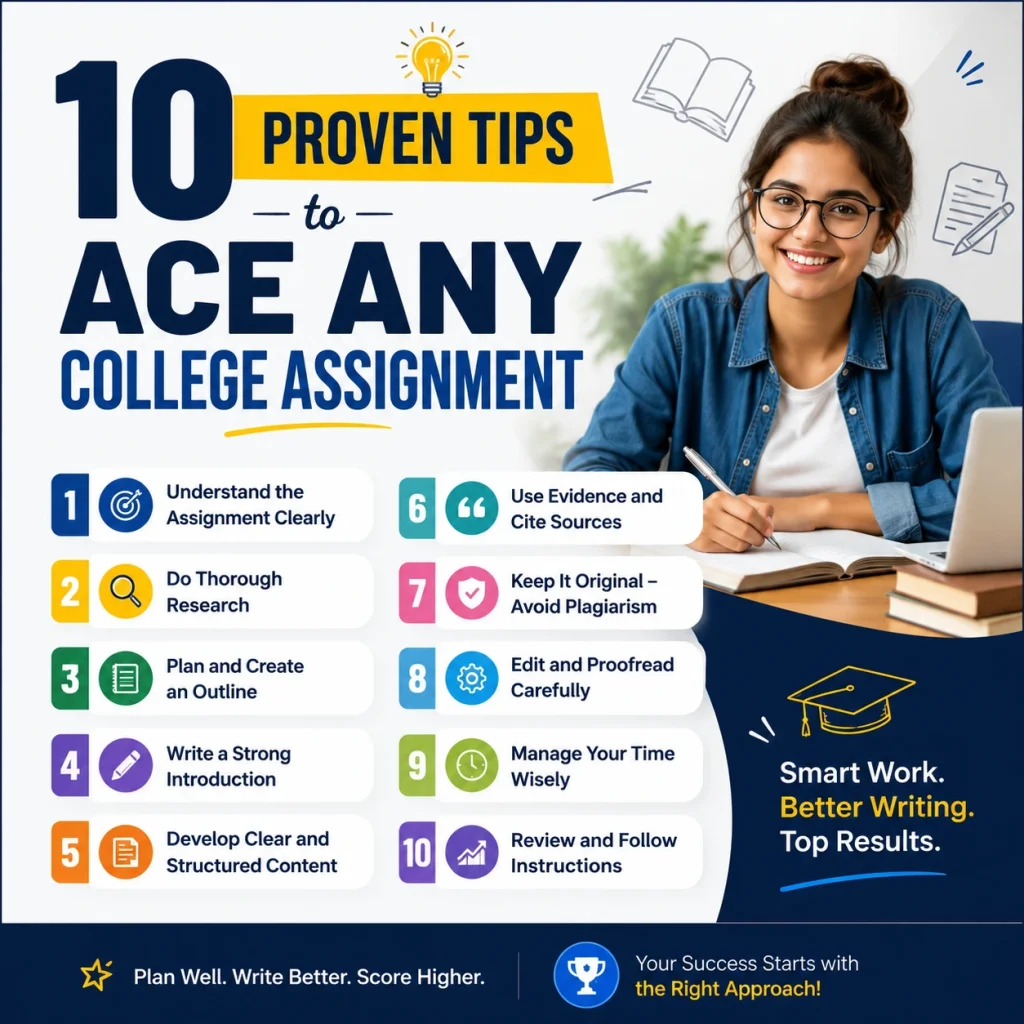
College assignments can be intimidating; with tight deadlines, strict rubrics, a lot of reading and high expectations. But after you’ve learned how to write academically, the whole process becomes lot easier. Master the basics, and each new assignment becomes a chance to demonstrate your skills, not a stress trigger.
Here is a step-by-step strategy to help you write better assignments. And on the way, you will also learn how assignmenthelpservice.org may help you when you need some expert advise or a little more support.
Before you begin a blank document or get started with brainstorming, take some time to read through the assignment prompt. Often students write poorly and lose points not because of the quality of their writing, but because they were not answering the question the professor was asking.
Read the prompt carefully and identify:
Ask your professor to clarify anything that is unclear, don’t make an educated guess Time spent now on answering a question will save you many marks later.
Have an elusive assignment brief that you need help understanding? You can send it to an expert at assignmenthelpservice.org and get a clear explanation, the suggested structure and main ideas to cover even before you begin writing.
Once you understand what you’re being asked to do, sketch out the basic structure of your assignment. A writing plan will save you hours of rewriting.
For a standard essay, you can usually rely on this simple framework:
Next, expand this outline by:
Don’t panic and do it late, as you should plan backwards from your deadline.
Estimate how long you’ll need for each stage:
Add extra time for unexpected issues and, if possible, leave at least one day of “rest” before your final edit.As you get further away from your draft, it’s easy to see your errors.
When time management is a problem, you can use assignmenthelpservice.org to divide your project into more manageable steps, or even find a tutor who will hold you accountable throughout the process, from coming up with the outline to submitting the finished product.
We are committed to helping you learn, Grow and succeed.
The introduction should form the tone for the whole assignment. Your professor will know you understand the matter and can communicate effectively in a strong opening.
Typically, a compelling introduction includes the following:
The thesis must be specific, focused and debatable. Don’t use general language such as “in this essay” or “this essay will examine. Rather, try something similar to: This essay proposes that formative feedback is more effective for enhancing student learning that standardized assessment..”
Unsure if your introduction is strong enough? Academic writers at assignmenthelpservice.org are able to provide you with a model introduction or to work on your thesis and provide it further solidity for the remainder of the assignment.
But once you get going on the writing, it’s simple to get caught up in a flashback to your main thesis or lose focus on what you’re writing because of social media, messages, or other tasks.
Use your outline as your roadmap:
You can make a huge difference in your focus with small habits:
Over time, this simple pre‑writing routine tells your brain: “It’s time to focus now.”
That mental prompt can make it a lot easier to get started — and usually the most difficult part.
Sometimes you have written a draft but it seems you are stuck or you are not sure if it really answers the question and if so, you need some shorter points on which to improve your writing so that it stays on point and remains sharp.
Academic writing is based on evidence and not personal opinion. Your arguments become convincing when they’re supported by credible sources.
Follow these steps to strengthen your evidence base:
Remember to not drop in a quote when you use evidence! Present it, define it and connect it to the thesis.
Need help locating high‑quality sources or integrating them correctly?Remember to not drop in a quote when you use evidence! Present it, define it and connect it to the thesis.
Beyond Description: Analyze, Interpret 6.
One of the initial academic errors that a student can make is to merely describe what other researchers have written, which is known as a description error. Analysis is expected in University-level work.
To go from description to analysis, it is important to:
Return to thesis in your discussion. All paragraphs should work toward answering the question or supporting the thesis.
Not certain if you’re analytical enough? At assignmenthelpservice.org, you can receive a comprehensive critique of your argument structure and depth of analysis from which you know you need to include more critical thinking.
Student Lose Marks
1 in 4 assignments fails to meet grading criteria due to poor structure, weak research, or plagiarism issues. A low score can impact your GPA and delay your academic progress. With expert assignment help, you can avoid these mistakes and secure better results from the start.
Structured paragraphs help the reader to understand and read your assignment. Your professor should be able to follow your logic without getting lost.
Aim for paragraphs that:
Keep each paragraph focused on one main idea only. If you find yourself introducing a new argument halfway through, that’s a sign you may need to split the paragraph into two.
Transitional words and phrases (such as however, moreover, in contrast, as a result, consequently) make the flow between ideas and ideas in text easier.
Paragraphs that are disjointed or repetitious can cause people to feel a lack of flow. Assignmenthelpservice.org editors can help you rearrange the content of your draft so that your ideas have sequence and connect with one another in a logical manner.
No matter how strong the argument, it can become discredited or unconvincing if the referencing is poor or inaccurate. Citing the work of others correctly not only helps you not to plagiarize but also demonstrates your respect for academic norms and the work of other scholars.
First, decide on the style of referencing that is required.. Common styles include:
Then, consult the most recent edition of the relevant style guide and pay attention to details such as:
Check that every source cited in the text appears in the reference list — and that every reference in the list is cited in your assignment.
If you get overwhelmed by the referencing aspect, you can let assignmenthelpservice.org help you with the formatting of your in-text citations and reference list in the proper style or check them to see if they conform to professor requirements.
Composing a draft is just half the task. The other half is editing – refining your work to be clear, polished and professional.
If possible, complete your draft and then take it away for a day. Come back with fresh eyes and see more:
Useful tools and strategies:
Your draft can be sent to assignmenthelpservice.org for deeper polishing on which the professionals will edit and proofread it. Experts will edit your language, correct your mistakes, and ensure your argument flows and sounds like you
One of the quickest ways to enhance your writing is to get feedback.Depending on the assignment and the rules of your university, you may:
Discuss it with your professor or teaching assistant, or get someone to check a plan out. Give and receive drafts with a classmate or study group.
Show your essay to a family member or friend for a “fresh reader” perspective on clarity.
Most importantly, plan ahead so you can submit on time. Communicate with your professor early if you are aware of the potential for difficulty with meeting a deadline and discuss extension options with him.
If you are pressed for time or need urgent assistance, assignmenthelpservice.org can offer you quick, personalized support, from outlining and research to complete drafting, which will enable you to complete your assignment without a last moment drama.
Improving your writing skills is no quick process. Practice is needed to:
The skills are important for more than just one grade. They enable you to communicate clearly in university, your career and every day problem solving. With these tips in mind, you’ll be able to step by step pick up the art of turning unclear assignments into clear, impactful work.
When you need a helping hand, expert eyes, or simply a second set of eyes, with assignmenthelpservice.org you can have them to help you through.



Contact Us
Our Services
100% Secure
SSL Encrypted
4.9/5 Rated
We accept:
VISA
Mastercard
Stripe
Wise
PayPal
Expert Help:
Copyright © 2020 – 2026 assignmenthelpservices.org 100% Success | Trusted in 65+ Countries | 4.9/5 Rated | 100% Secure Payments



