
Writing a literature review is one of the most challenging parts of any academic assignment or research project.The Literature Review: Your Reference Map to Many High-Scoring Papers.
 Understand Existing Research Thoroughly
Identify Key Knowledge Gaps
Analyze Theories And Findings
Compare Different Scholarly Perspectives
Build Strong Academic Arguments
Organize Information Logically
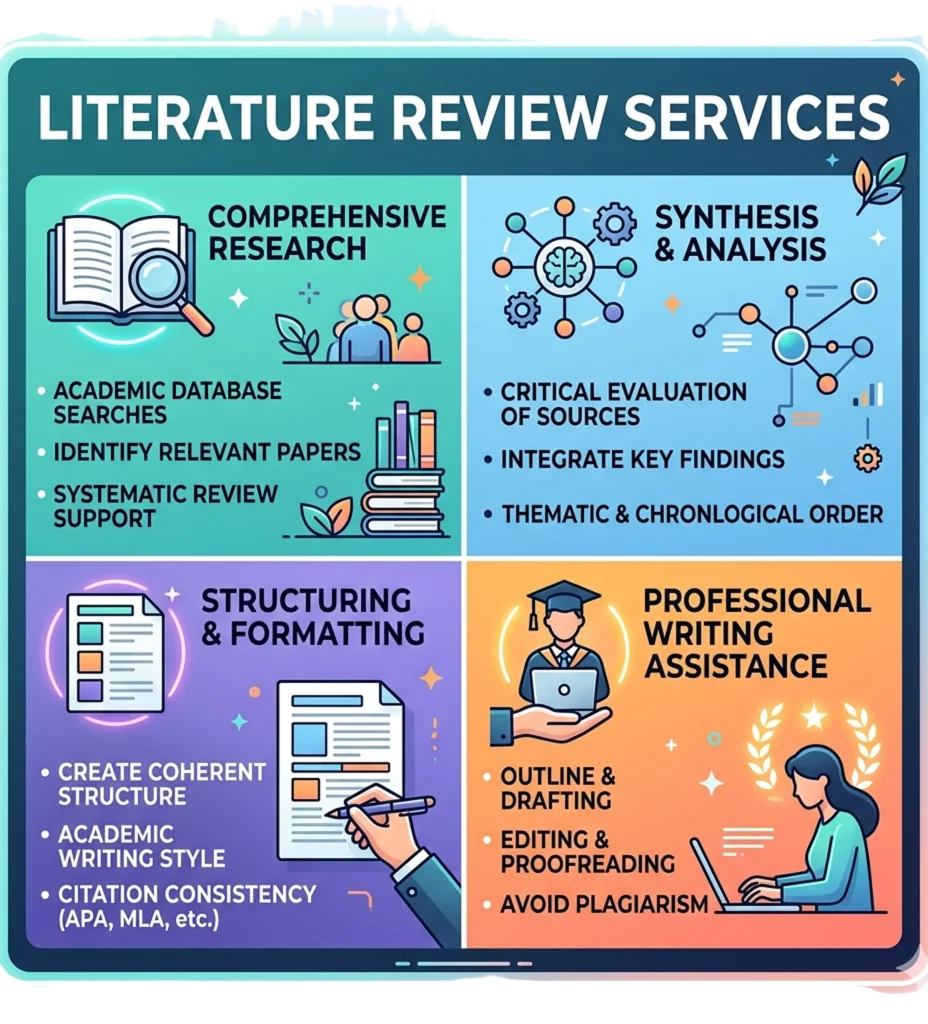
A literature review is a systematic summary of the research that has been conducted previously on a specific topic. It does not present new data but reviews the data, findings, arguments, and conclusions of other scholars.
A good literature review:
Consider it the backbone of your assignment or research paper. Lack of literature review can leave your work unsupported, obsolete, or with little relation to the scholarly dialogue.
Many students often perceive the literature review as a task to be completed, but actually, it is a very significant component of the academic work. It is crucial because it:
Shows your understanding of the field: Examiners want to see that you are familiar with major authors, debates, models, and approaches.
Helps refine your topic: As you read, you often discover that your initial idea can be sharpened, narrowed, or expanded for better clarity and focus.
That is why you should always take special care in the quality of your literature review when writing your assignments and expect lecturers and supervisors to pay a close eye on it when assessing.
# If you find literature reviews difficult, you’re not alone. All students in all subject areas have a problem with:
Information overload: There are thousands of articles, books, and reports. Knowing what to include and what to exclude can be confusing.
The problems you are facing can result in stress, rushing through writing and grades that are lower than you deserve. That’s why services like assignmenthelpservices.org are available; to help you through each step clearly and with support.
Below is a simple, practical process you can follow. This heading is presented in table format for clarity and easy reference.
Step | What To Do | Key Focus |
1. Clarify your topic and question | Define the exact focus of your assignment or project. Ask: What is my research or debate about? | Narrow, clear research question or objective |
2. Search strategically for sources | Utilize Google Scholar, JSTOR, your university library and subject databases. Identify keywords and note recurring authors/journals. | Effective and targeted search—no random surfing |
3. Filter and select sources | Always start with the titles, abstracts, and conclusions. Choose recent, relevant, and reputable sources (especially peer-reviewed). | Quality over quantity; relevance to your topic |
4. Take organized notes | Document important concepts, techniques, discoveries, and constraints . Note how each source links to your question and to other studies. | Consistent note-taking system (tables, spreadsheets, or apps) |
5. Group by themes or concepts | Organize studies under similar themes, approaches or concepts (motivation, online learning resources, assessment techniques etc.). | Rather than summary article by article, themed or conceptual structure. |
6. Analyze, don’t just describe | Compare and contrast findings. Ask: Do authors agree? Where do they differ? What are the gaps? | Critical thinking and evaluation, not only summary |
7. Write in a logical flow | Focus on general background first, more specific, and recent studies.Use transitions between paragraphs and sections. | Clear, connected narrative that reads smoothly |
8. Conclude with a clear summary | Highlight what is known, what is still unclear, and how your assignment or research will contribute. | Shows the value and purpose of your own work |
Remember, this is such a daunting process that you can always call in the expert academic writers at assignmenthelpservice.org to help you find sources that you need and to edit your final draft.
We are committed to helping you learn, Grow and succeed.
We at assignmenthelpservice.org are experts at helping students with complicated assignments such as literature reviews. We can help you to improve both the quality of your work and your confidence in the following ways:
You are not only enhancing one assignment, but you are learning how to do academic research better in the future by working with assignmenthelpservice.org.
The good literature review is not just a formality but the backbone of a good, well argued well researched assignment. It shows your ability to:
If you are stuck, stressed or unsure where to start, you’re not in it alone. AssignmentHelpServices.org or any other expert essay writing service is here to help you with the best guidance available, a reliable and quiet research support, and a professional written essay that fits your needs.
Turn your literature review from a source of anxiety into a powerful part of your academic success with the right strategy, and the right support by your side.
Student Lose Marks
1 in 4 assignments fails to meet grading criteria due to poor structure, weak research, or plagiarism issues. A low score can impact your GPA and delay your academic progress. With expert assignment help, you can avoid these mistakes and secure better results from the start.



Contact Us
Our Services
100% Secure
SSL Encrypted
4.9/5 Rated
We accept:
VISA
Mastercard
Stripe
Wise
PayPal
Expert Help:
Copyright © 2020 – 2026 assignmenthelpservices.org 100% Success | Trusted in 65+ Countries | 4.9/5 Rated | 100% Secure Payments


