
Accurate citations and references are essential for academic success. Our bibliography writing services help students create properly formatted bibliographies that meet university requirements, enhance credibility, and ensure compliance with APA, MLA, Harvard, Chicago, and other citation styles.
 Gather all sources before bibliography creation
Verify citation details for complete accuracy
Follow required referencing style guidelines carefully
Organize references in correct alphabetical order
Ensure consistency across all source citations
Avoid citation errors that affect grades
Use expert bibliography writing services confidently
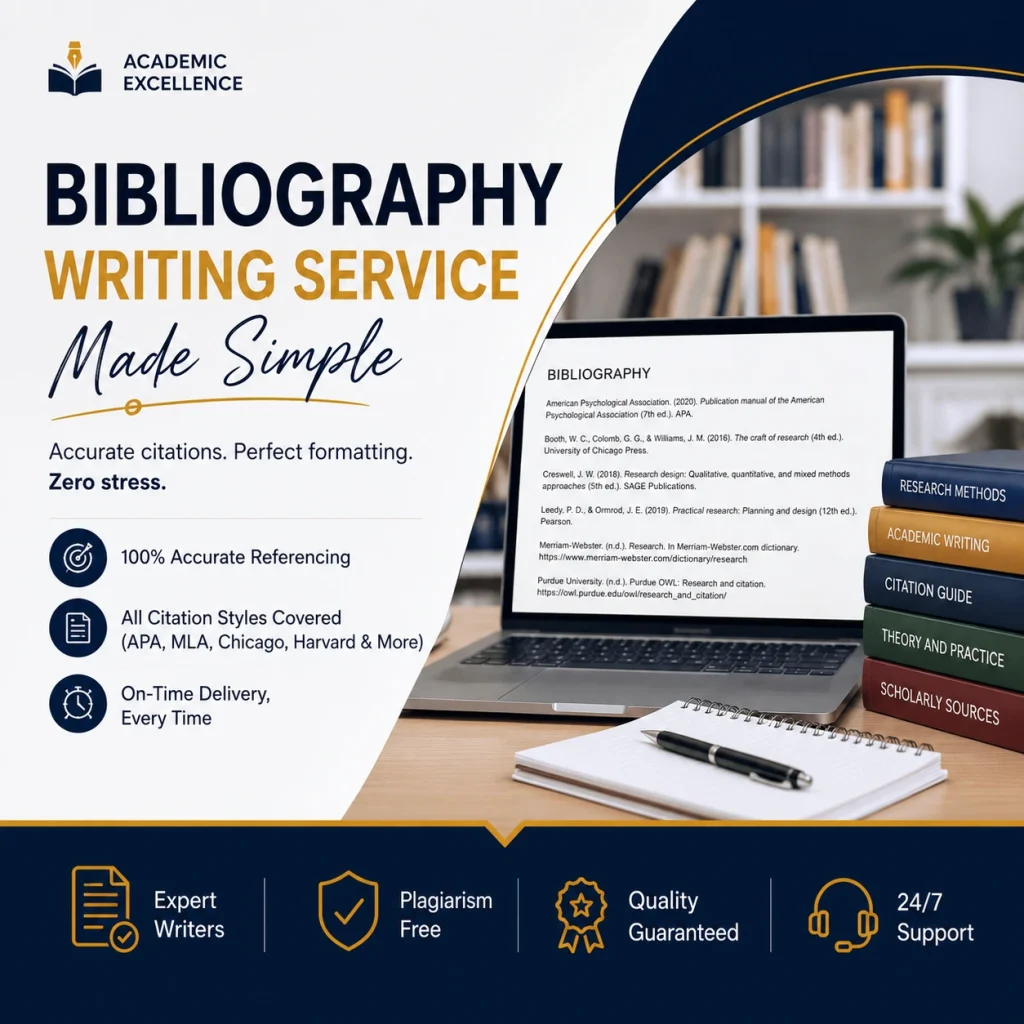
So, creating a bibliography can initially be intimidating. Many names, dates and rules. But it doesn’t have to be so difficult. After having mastered the steps, bibliography writing can be lucid and even somewhat fascinating.
In this blog, we will talk about:
A bibliography is a list of sources you used for your research or essay. These sources can be:
You list them in a set way, often in alphabetical order by the author’s last name. A basic bibliography only shows the details of each source, like author, year, title, and where it was published.
So it answers this question: What did I read for this project? This is the initial step to writing good bibliography.
An annotated bibliography adds an extra comment to the list of reference. It contains all the standard information from each source. Then it attaches a little note, which it calls an annotation.
This annotation usually has two parts:
So it answers two questions:
If you feel lost, it is totally fine to look for annotated bibliography help from your teacher, tutor, or writing center.
Your teacher may ask for different things, but a strong annotation often:
Here is a simple table to show the parts.
Part of annotation | What you write | Simple example question |
Summary of main idea | What the author is trying to show or explain | What is the main point of this source? |
Method or approach | How the author did the research (survey, case study, theory) | How did they study the topic? |
Key findings | The most important results or claims | What did they find or argue? |
Your evaluation | Why it is useful, strong, or weak for your project | How will this help my paper? |
Connection to your work | How it relates to your research topic | How does this link to my research question? |
Use this as a small checklist when doing bibliography writing for school.
We are committed to helping you learn, Grow and succeed.
The quality of your annotated bibliography depends on the quality of your sources. Before you start writing, stop and think about your topic.
Ask yourself:
You may need:
Look for studies that are used in many other books. Their reference lists can be used to identify key names and titles.
This early thinking will save a lot of time later and make bibliography writing smoother.
Avoid simply listing the topics discussed in the article when writing an annotation. Attempt to get the central point of the argument.
It is easy to understand in terms of the following.
Always read the introduction and the conclusion first. Ask:
Write this in one or two sentences that are easy to understand.
Look out for repeated words or concepts. They are frequently used to indicate the central idea.
Ask yourself:
This will prevent you from copying lines, and make you understand the logic instead.
Check how the text is built:
Often, the first sentence of each paragraph gives the key idea. This is a good place to look while you prepare your annotation.
Your summary should be brief. Typically one paragraph will suffice. Focus on:
Avoid attempting to address all minor details. This will make your annotated bibliography difficult to read.
Summary is not enough for a good annotation. It also provides information about the usefulness of the source to your research.
Here are simple questions you can answer in one or two lines:
You can also think about limits:
In your annotation, call out 1 or 2 of these. This is a major aspect of making good bibliography.
When you need it, don’t hesitate to seek friends’ or tutors’ or a writing lab’s assistance, or use an annotated bibliography to help you. Be sure that you write in your own words in the final work.
Student Lose Marks
1 in 4 assignments fails to meet grading criteria due to poor structure, weak research, or plagiarism issues. A low score can impact your GPA and delay your academic progress. With expert assignment help, you can avoid these mistakes and secure better results from the start.
Not every teacher wants the same thing. Always check your assignment sheet. Some tasks may ask you to:
If your list is long, it can help to put it into sections. For example:
This will make your writing easier to read, and demonstrate your knowledge about your subject.
Here are a few quick tips to keep in mind.
Working on one source at a time makes the task less daunting.
If you don’t write the bibliography perfectly, it can still be good. You need to be clear and honest about what each source is saying, and how it relates to your project. An annotated bibliography is NOT just a list. It’s a miniature map of your Research Thinking.
When you:
you demonstrate a deeper understanding of your topic.
Don’t hesitate to use the annotated bibliography help, if you need it. Ask questions, go step-by-step and your next bibliography will be much easier.



Contact Us
Our Services
100% Secure
SSL Encrypted
4.9/5 Rated
We accept:
VISA
Mastercard
Stripe
Wise
PayPal
Expert Help:
Copyright © 2024 – 2027 assignmenthelpservices.org 100% Success | Trusted in 65+ Countries | 4.9/5 Rated | 100% Secure Payments



