
Reflective essays require more than describing an experience. Our reflective essay help experts assist Australian students in developing critical reflections, connecting theory with practice, and presenting personal insights in a clear, academically structured format.
 Understand reflection purpose before starting writing
Choose meaningful experiences supporting your discussion
Describe events clearly and objectively first
Analyze lessons learned from each experience
Connect reflections with relevant academic theories
Maintain logical structure throughout the essay
Seek reflective essay help for guidance
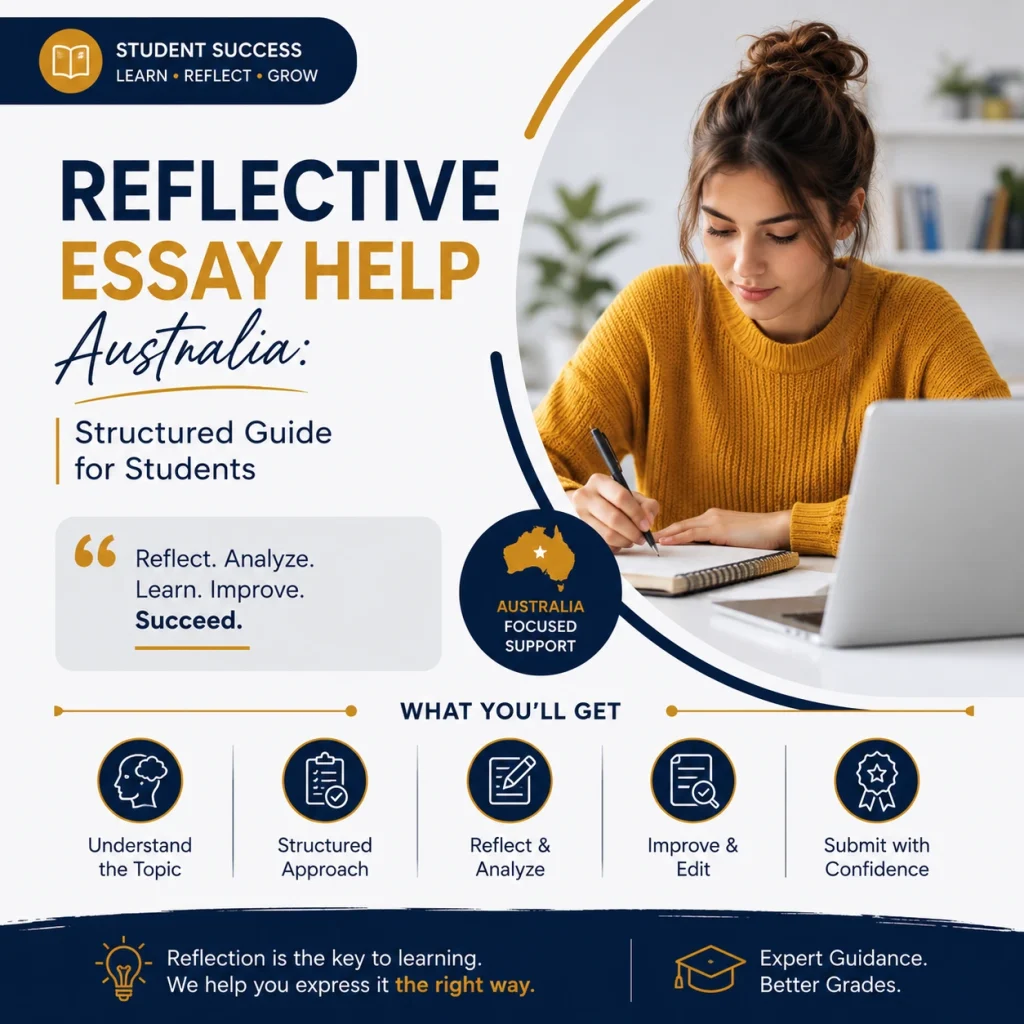
Reflective essays are now an integral part of many courses at universities in Australia, particularly in nursing, education, social work, psychology, and business. They often sound confusing due to their combination of personal experience and academic analysis.
Reflective essay is a written piece that reflects on an experience, examines it through theory or a model and discusses how it relates to your practice in the future.
Key features of reflective essays
Aspect | Description |
Focus | Your own experience, actions, thoughts, and feelings |
Style | First person (“I”, “my”), but still academic and structured |
Purpose | To learn from experience and show professional growth |
Common disciplines | Nursing, education, social work, psychology, business, management |
Typical requirements | Adopt a reflective model; reference theory, policy or professional standards |
It’s not just a statement of what happened, it’s an explanation of why it’s important and what you will do different next time.
Reflective essay is difficult to write for many students in Australia due to the need to combine emotions, experience and academic theory in the essay.
Common challenges
This is why students look for reflective essay help Australia to know the structure and presentation of their reflection.
We are committed to helping you learn, Grow and succeed.
Short description:
Reflective models give you a clear framework so your writing is organised and critical, not just a story.
Model | Stages / Questions | Common Use Areas |
Gibbs’ Reflective Cycle | Description, Feelings, Evaluation, Analysis, Conclusion, Action Plan | Nursing, healthcare, social care |
Kolb’s Learning Cycle | Concrete Experience, Reflective Observation, Abstract Conceptualisation, Active Experimentation | Education, training, business, PD |
Driscoll’s What Model | What? So what? Now what? | Nursing, education, early reflections |
Short description:
A six-stage model that helps you explore an experience in depth.
Stages in point form:
Short description:
A four-stage model focused on learning from experience and applying it to future practice.
Stages in point form:
Short description:
An easy-to-use model with three questions that can motivate critical thinking.
Key questions:
In assignmenthelpservices.org, our experts employ any reflective model your Australian university requires and apply it correctly.
We provide focused assistance to make sure your reflective essay is organized, critical and on track with your marking rubric.
Support Area | What We Do |
Model selection & structure | Choose the right model (Gibbs, Kolb, Driscoll, etc.) and organise your essay around its stages |
First-person academic writing | Maintain a personal “I” voice while keeping language clear, formal, and appropriate |
Theory and literature integration | Link your experience with key concepts, guidelines, or peer-reviewed sources |
Discipline-specific guidance | Provide tailored support for nursing, education, social work, psychology, business, and more |
Alignment with Australian rubrics | Focus on criteria such as depth of reflection, criticality, structure, and referencing |
Confidential and original work | Deliver plagiarism-free, confidential help before your deadline |
If you wish to get assistance with reflective essay writing in Australia, you typically approach the services for the following reasons:
We guides you through each of these challenges.
Here are simple, direct steps you can follow to strengthen any reflective essay.
Student Lose Marks
1 in 4 assignments fails to meet grading criteria due to poor structure, weak research, or plagiarism issues. A low score can impact your GPA and delay your academic progress. With expert assignment help, you can avoid these mistakes and secure better results from the start.
It is a very simple table between describing an event and doing some actual reflection.
Type | Example |
Description | This simple table shows the difference between just describing an event and doing real reflection. |
Reflection | Removing the nervousness aspect of the situation led me to skip important assessment steps which could impact patient safety; next time I will use a checklist and practise the procedure in simulation to increase my confidence.” |
Reflective essays always move from description to meaning and future action.
There’s no need to be confused or stressed when writing a reflective essay. By using the right model, having a clear structure, and being guided by assignmenthelpservices.org, you can make your real-life experiences impactful reflections that will impress your markers and confidence you as a future professional.






Contact Us
Our Services
100% Secure
SSL Encrypted
4.9/5 Rated
We accept:
VISA
Mastercard
Stripe
Wise
PayPal
Expert Help:
Copyright © 2020 – 2026 assignmenthelpservices.org 100% Success | Trusted in 65+ Countries | 4.9/5 Rated | 100% Secure Payments



